Water Carrier
Sculptor Romualdas Kvintas. 2020
Read the full poem
You are a dark amulet set in Lithuania.
Old gray writing – mossy, peeling.
Each stone a book; parchment every wall.
Pages turn, secretly open in the night,
As, on the old synagogue, a frozen water carrier,
Small beard tilted, stands counting the stars.
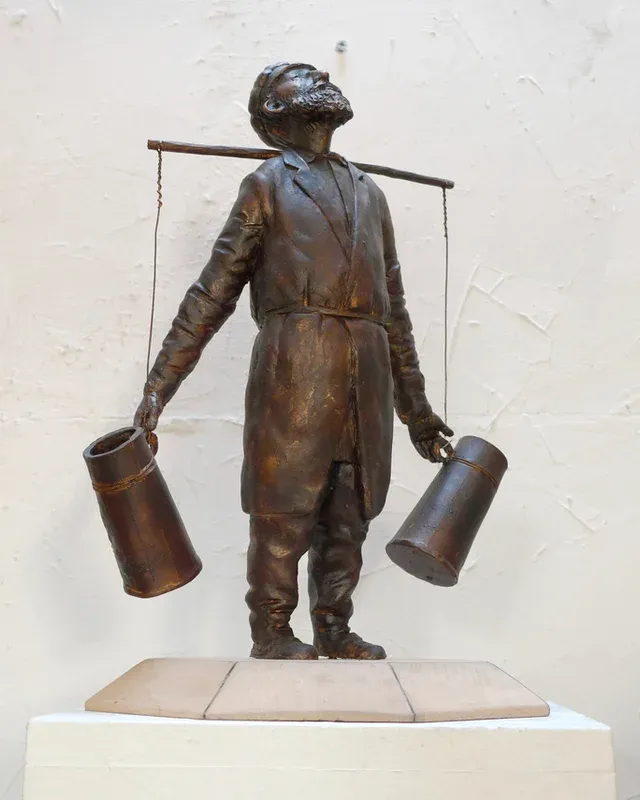
Monument to idealism
The work of the water carrier in Vilnius was important, even though those who were engaged belonged to the poorest inhabitants of the city. The subject of the statue symbolizes idealism, which was abundant even in the most difficult times.
Romualdas Kvintas (1953–2018)
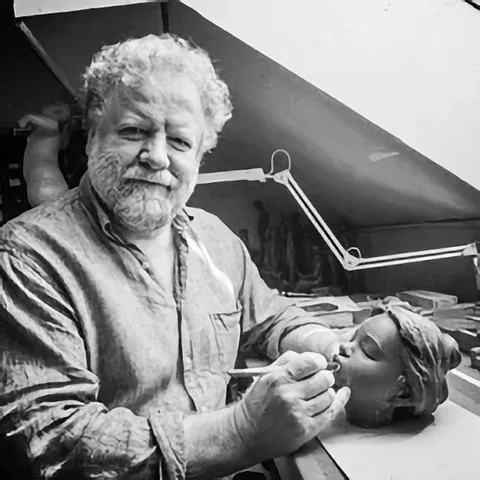
The Lithuanian sculptor Romualdas Kvintas is known for many works, e.g. statues commemorating Vytautas Kernagis in Nida, the writer Romain Gary, the physician Dr. C. Shabad, the singer D. Donskis and the linguist J. Jablonskis. In the autumn of 2015, a sculpture by Kvintas dedicated to Hermann Kalenbach and Mahatma Gandhi was erected in the town of Rusne; in the fall of 2017 this was followed by his statue of the church reformer Martin Luther in Vilnius. In the fall of 2019, a year after the sculptor’s death, a sculpture for the singer, poet and artist Leonard Cohen was unveiled.
The sculptures of Romualdas Kvintas are characterized by a special feeling of coziness, of perfection, sensitivity, and have a characteristic shape. Important people are presented as normal people, and the sculptures have a real-life size. A direct eye-to-eye communication between the sculpture and the viewer is probably one of the most significant features of Romualdas Kvintas’ oeuvre.
Moyshe Kulbak (1896–1937)
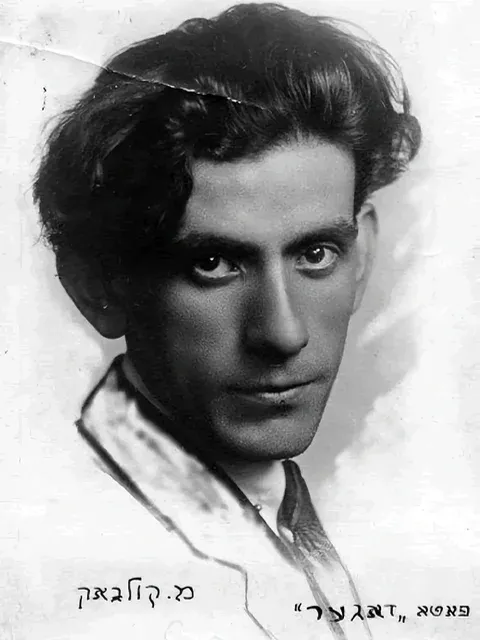
Moyshe Kulbak was born in Smarhon (present-day Belarus, then a town of the Russian Empire), grew up in a religious Jewish family, studied at the state Jewish school, attended the cheder in the evenings, and later the Švenčionys and Volozhin yeshivas. When the First World War broke out, Kulbak’s parents and relatives moved to Minsk, while he taught at a Jewish orphanage in Kaunas. In 1919 he moved to Vilnius. From 1920 to 1923 he lived in Berlin. In 1923 he returned to Vilnius, which was a center of Yiddish literary culture, where he taught modern Yiddish literature at the Real-Gymnasium (a Yiddish-speaking high school) and at the Yiddish teachers’ seminary. In 1927 he was elected the first president of the World Jewish PEN Club. In 1928 the writer moved to Minsk (capital of Soviet Belarus), where much of his family lived and where there was a lively Yiddish literary scene. In 1937 Kulbak was branded an “enemy of the people,” accused of being a member of an anti-Soviet organization and a Polish intelligence agent; his works were banned and he was locked up in a Soviet Gulag concentration camp. He was executed (shot) in 1937. His burial place is unknown. In 1956 the poet was rehabilitated.
Moyshe Kulbak began writing poems and prose in Hebrew, and later wrote in Yiddish. He is considered a creator of deep intellect and great spirit, fusing in his books the philosophy of Kabbalah and Jewish folklore with Western European thought and its literary mentality. In many ways, Kulbak’s work is a synthesis of Lithuanian Jewish literary modernism.
One of the most significant works of Kulbak is the poem “Vilna” (1926), which is considered the deepest and most beautiful work about this city. Using gentle elegiac free verse, unexpected metaphors and bold generalizations, the poet draws a laconic and expressive image of Vilnius.
Ambassador Matthias Sonn talk at Unveiling of the Statue of the Water Carrier, Vilnius October 19th, 2020
2020 is the year of the Gaon, born 300 years ago. 2020 finds Germany in the lead of the International Holocaust Remembrance Alliance. All IHRA countries have committed to look the past straight into its eye. We know, it is impossible to undo the atrocities, revive the murdered, or reverse the barbarities. But it is possible to learn and remember how Lithuania became part of the larger region which Timothy Snyder named “Bloodlands”. Hitler’s seemingly unstoppable might assured that from 22nd of June 1941 onwards, when Nazi Germany attacked the Soviet Union, all remaining standards of civilization were thrown overboard. Whole categories of people, young and old, lost the most elementary human right - the right to life. The word “Shoa” designates - not a persecution for what one did, said or thought, but for who one “is”: genocide.
Death itself became, as the Romanian Jewish writer Paul Celan put it in his incomparably haunting “Todesfuge”, the “Fugue of Death” in 1945, “a master from Germany”. Celan wrote in German, so let me quote the original – “der Tod ist ein Meister aus Deutschland”. So it remained - Death, a master from Germany until 1945. The historical responsibility remains. It remains, of course, mainly with us Germans. Today, and always.
The Nazi German genocidal drive, however, also placed the “Bloodlands” in front of moral choices almost impossible to withstand with honour; among them, Lithuania. Yes, the “righteous among the nations” are a brave and a small crowd. Anywhere, everywhere. And it is a hard, tortuous process for any country to look into the mirror of its own historical ambiguities. Especially when these dilemmas, these ambiguities, were imposed from outside; when they were not homemade.
Today, I commend the city of Vilnius, the former “Jerusalem of the North”, for contributing; for serving the cause of historical honesty; for resisting the almost irresistible temptation to cultivate an easy, undifferentiated, exculpatory narrative of one’s own victimhood; for giving us a memorial, a place, an image to help us all remember what was wantonly and brutally destroyed here – hundreds of years of Jewish life, Jewish learning, Jewish culture, of the Yiddish language as a living, spoken medium.
First of all, I thank the Mayor of Vilnius, I thank you, dear Remigijus Simasius. The modest “Water Carrier” statue we unveil today is a small “aide mémoire”, as we diplomats call it: Jews once played a particularly important role in what was then Wilno or Wilna. They made it an intellectual centre of Europe, called the “Jerusalem of the North”. Around 95 % of the Lithuanian Jews were killed while my country held sway here. Finally, in 1945, the Red Army conquered Berlin and freed us Germans from Hitler – only to replace his rule with Stalin’s repression. Lithuania’s historical museum, based in former Gestapo and KGB headquarters on Gedimino Prospektas, tells the story. Its internet address is genocide.lt. That is why such a transcendental sculpture is needed.
Vilnius’s new Water Carrier, a work of the sculptor Romualdas Kvintas who died two years ago, is to me a uniquely fitting memorial. Romas Kvintas does not show us one of the Great and the Good of Jewish learning, art or literature. What we see is a modest man in his modest life, a life of hard work and little ambition, a life of no pretension. A harmless life, most certainly. That’s precisely why I find this monument so monumentally touching: because it is entirely non-monumental; almost ostentatiously at eye level with us. And yet, this ordinary working man is looking up to the heavens. Does he see the stars there? Do they give him solace?
I conclude. For half a century, two East German and Lithuanian generations were kept behind the iron curtain until they could reconquer freedom – those whose families had not been murdered under Nazi German occupation, that is.
Together, Lithuania and Germany today support the people in Belarus to finally achieve the same. Let us enjoy our freedoms and make responsible use of them in times of Corona. Let this statue of the water carrier strengthen our empathy, our will to think of the poor, of the ones in need. His look toward the heavens makes us understand how privileged we are. How thankful we must be to live in so much better times - far away from the horrors this water carrier must have seen. And how could we be thankful if we allowed those horrors to be forgotten?
Thank you for your kind attention.